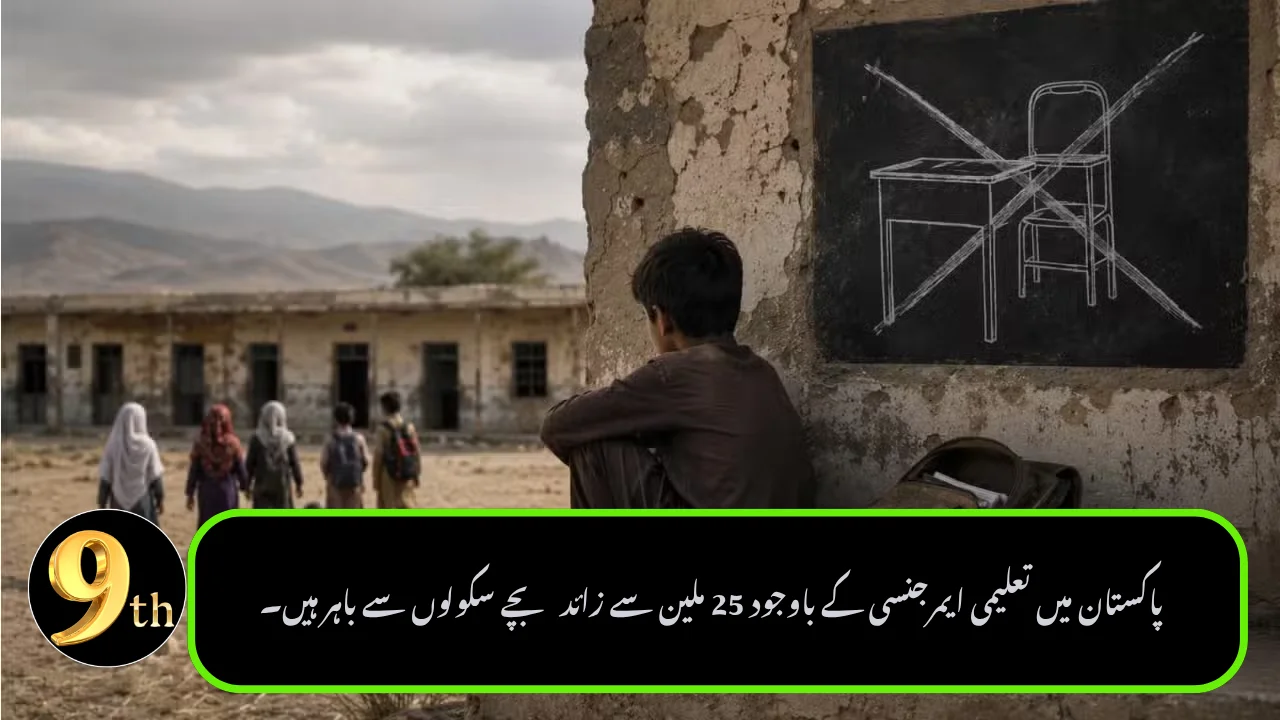
More than 25 million children in Pakistan are still out of school despite the federal government’s declaration of a National Education Emergency more than two years ago, according to a new policy review by the Civil Services Academy (CSA).
The report concludes that while governments have introduced ambitious education reforms under the National Education Action Plan (NEAP) 2026, weak implementation continues to hinder progress.
Education Crisis Persists
According to the CSA report, Pakistan currently has between 25.1 million and 26 million out-of-school children, placing it among the countries with the highest number of children deprived of education.
The report notes that this situation persists despite Article 25-A of the Constitution, which guarantees free and compulsory education for children.
Key Challenges Identified
The policy review attributes the continuing education crisis to several long-standing issues, including:
- Chronic underfunding of education.
- Weak governance.
- Fragmented policymaking.
- Poor implementation of education reforms.
- Rapid population growth.
- Poverty.
- Inadequate public education infrastructure.
The report states that these structural challenges have contributed to the growing reliance on low-cost private schools in many parts of the country.
Punjab Has the Largest Number of Out-of-School Children
Among all provinces, Punjab carries the largest share of Pakistan’s out-of-school children.
According to the Punjab School Education Department’s 2026 baseline report, cited in the study:
- 6.4 million children have never enrolled in school.
- 3.16 million children have dropped out.
Overall, Punjab is estimated to have between 9.6 million and 10.4 million out-of-school children.
The report notes that improving student retention is as important as increasing enrolment.
Province-Specific Challenges
The review highlights that each province faces distinct educational challenges.
Sindh
- High dropout rates after primary school.
- Frequent climate-related disruptions affecting education.
Khyber Pakhtunkhwa
- Security concerns.
- Difficult geographical terrain.
- Shortage of female teachers.
Balochistan
- Weak institutional capacity.
- Inactive schools.
- Scattered population, making service delivery more difficult.
Islamabad, Gilgit-Baltistan, and Azad Jammu & Kashmir
Although these regions generally report higher enrolment rates, the report says educational inequalities continue to exist within their populations.
Need for Better Implementation
While acknowledging that the National Education Emergency has increased political attention on education, the CSA concludes that meaningful progress will require:
- Stronger implementation of education policies.
- Improved governance and accountability.
- Greater investment in education.
- Province-specific strategies rather than a one-size-fits-all approach.
The report emphasizes that policy announcements alone will not resolve Pakistan’s education challenges without sustained action on the ground.