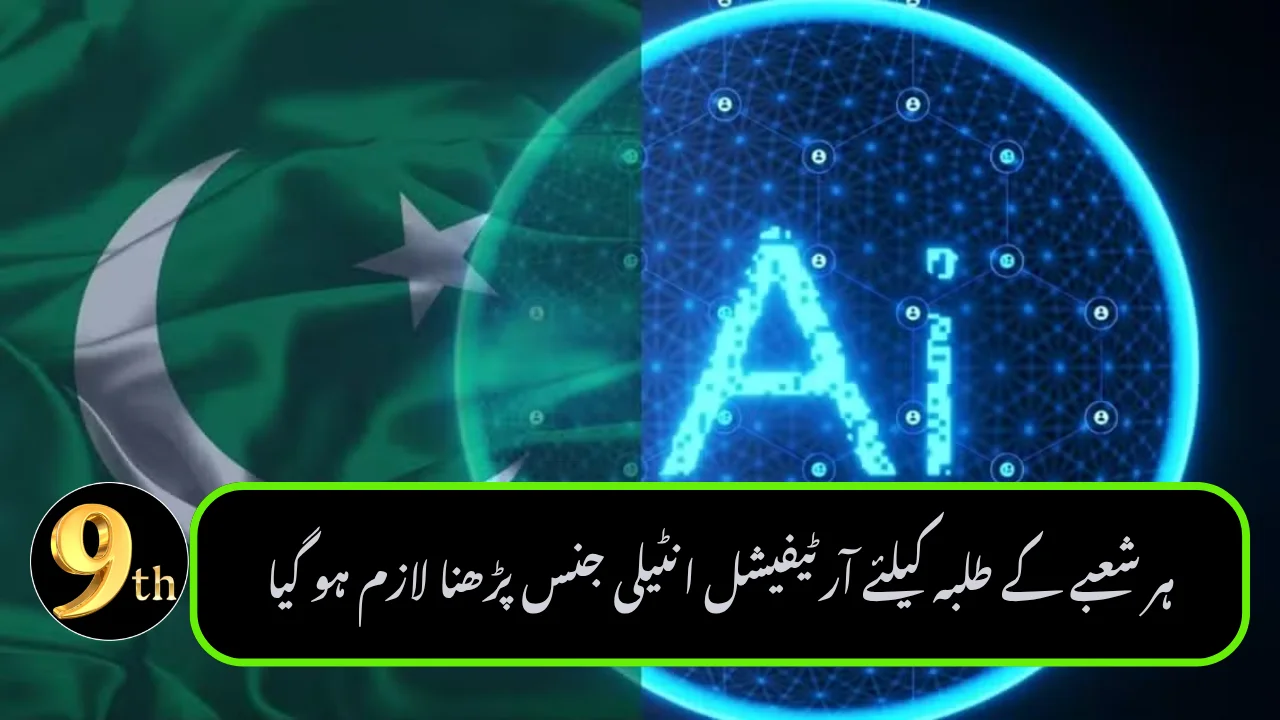
In a major step aimed at preparing Pakistani graduates for the AI-driven global economy, the Higher Education Commission (HEC) has decided to make an Artificial Intelligence course compulsory in every university across the country. The new rule will take effect from the Fall 2026 semester and will apply to all undergraduate and postgraduate students, no matter what subject they are studying.
What the New Rule Says
According to the HEC, all universities in Pakistan, both public and private, will be required to include a three-credit-hour Artificial Intelligence course in their degree programs. The requirement will apply across the board, meaning:
- All undergraduate degrees
- All postgraduate degrees
- Every academic discipline (arts, sciences, commerce, engineering, medicine, and more)
In simple words, whether you are studying literature or business, engineering or law, you will now have to complete an AI course as part of your degree.
Why HEC Took This Step
The commission says the aim behind this decision is to give graduates basic AI knowledge and practical skills that are now considered essential in a rapidly changing global economy. Artificial Intelligence is already reshaping industries such as banking, healthcare, media, marketing, and even government services. Without at least a basic understanding of AI, fresh graduates could find themselves at a serious disadvantage in the job market.
By making AI a compulsory part of higher education, HEC wants to ensure that every Pakistani graduate walks out of university with a working understanding of the technology that is set to define the next decade.
Decision Taken in HEC’s 47th Meeting
The decision was formally approved during the 47th meeting of the Higher Education Commission. The meeting was chaired by HEC Chairman Dr. Niaz Ahmad Akhtar at the commission’s secretariat in Islamabad.
Several key stakeholders attended the session, including:
- Federal representatives
- Provincial representatives
- Vice chancellors of universities
- Other commission members
Their presence gave the decision broad backing from across the higher education sector.
Framework for Generative AI Use Also Approved in Principle
Along with the mandatory AI course, the commission also gave in-principle approval to a national framework on the responsible use of Generative Artificial Intelligence in higher education institutions. This framework is expected to set clear guidelines on how students, teachers, and universities can use tools like ChatGPT and similar platforms in a responsible way.
However, the draft was returned to the HEC Secretariat so that further recommendations from commission members could be added before it is officially notified. So while the direction is clear, the final rules on Generative AI use are still being finalized.
Data Protection Policy Also on the Table
The commission also considered a proposed Data Protection Policy that would cover the sharing of institutional data with external government organizations through APIs. This policy also received in-principle approval, but it was sent back for further legal and technical refinement based on the feedback given during the meeting.
If passed, this policy would be an important step in protecting sensitive student and university data as institutions increasingly connect their systems with government databases.
What This Means for Students
For current and future university students, this decision has some clear implications:
- You cannot skip the AI course. It will be as compulsory as core subjects.
- It will take up three credit hours in your total degree plan.
- Universities will need to update their curriculums and hire trained faculty.
- Employers will soon expect graduates to have at least basic AI knowledge.
What This Means for Universities
Universities also have work ahead of them. To meet the Fall 2026 deadline, they will need to:
- Design or adopt a standardized AI course
- Train or hire qualified faculty
- Ensure lab and software support for practical learning
- Align the course content with HEC’s approved framework
Smaller universities, especially those without strong tech departments, may face a bigger challenge in meeting the new requirement on time.
A Step in the Right Direction
Overall, the HEC’s decision is being seen as a much-needed step to align Pakistan’s higher education system with the demands of the modern world. Countries around the world are already integrating AI into their education systems, and Pakistan cannot afford to fall further behind.
For students, this is a clear signal that AI is no longer optional. It is becoming a basic academic and career skill, just like using a computer became compulsory two decades ago. Those who take the course seriously and build on it will be in a much stronger position when they step into the job market.